27th June 2022
We woke to another bright, sunny day, but the sea was rough, with white-topped waves making it difficult to tell whether we were surrounded by the largest pod of whales on the planet, or if it was just wishful thinking. The wind was bitterly cold, making our post-breakfast stroll around the decks distinctly unpleasant. Conditions had worsened by the time we ventured out again for some pre-lunch exercise. Battling into the teeth of a gale on the forward march toward the bow used up enough calories for several meals. We called it a day after a single circuit and retreated to the bowels of the Ambience to replenish our reserves.
The afternoon lecture proved to be a highlight. Louis Rudd MBE, record-breaking polar adventurer, expedition leader, former Royal Marine, and SAS soldier, is the only person to have traversed Antarctica twice using human power alone. This, the first of two lectures, focused on a 2018 expedition during which he and a small team crossed the Greenland ice sheet. It was a fascinating account, full of highs, lows, and the considerable dangers of exploring such a remote and unforgiving region.
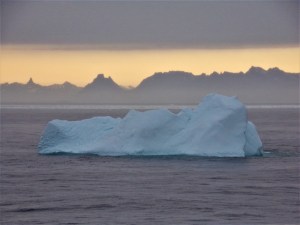
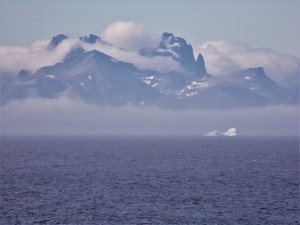
Around four in the afternoon, shortly after the snow-capped mountains of southern Greenland appeared a few miles off the port bow, we encountered icebergs. We were sailing along a coastline that looked like the most inhospitable shoreline I have ever seen, grey, threatening mountains rising vertically through a layer of ice-cold mist. I can’t imagine anything choosing to live here, not even the hardiest of creatures, yet the naturalists on board assure us that life does persist in this desolate region.
Our captain kept the ship well away from the icebergs ominously floating by, forcing me to zoom in on my camera to capture these deceptive lumps of ice. Even on the sheltered aft deck outside our room, I couldn’t last long with my fingers exposed on the shutter button. Yet, a couple of cruisers remained blissfully unperturbed, toasting the passing scenery with glasses in hand from the steaming hot tubs for over an hour. Not my idea of a good time.
Just before we returned to our cabin for the night, we spent some time on the aft deck watching icebergs of all sizes slowly drift by the ship. At 10:30 pm, it was as light as day, the sea was dead calm, and the ship had stopped. The rest of the passengers were either enjoying the entertainment deep inside the Ambience or snugly tucked up in bed. It was wonderfully peaceful, and we were alone in a scene of raw nature. Then, it began to spit with rain!
29th June 2022: Qaqortoq
 Today, we were scheduled to begin a Cultural Walking Tour of Qaqortoq at 8:30 am on the quayside of the port, but as this was a tender port, we had to gather in the Palladium for 7:45 am to be ferried to the shore. However, that didn’t happen.
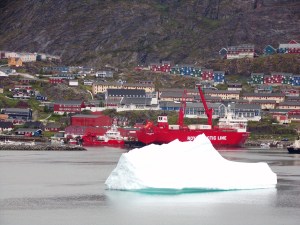
We duly breakfasted at 6:30 am, only to be disappointed to find it was raining. Our anchorage, just a few hundred metres from the town, offered a rather miserable view of the surrounding scenery. A smaller cruise ship lay at anchor a little closer to the settlement, and scattered around both vessels, as far as we could see, were icebergs of all sizes. The sea was calm and flat, disturbed only by falling raindrops. Some of the bergs were a striking blue, while others contained bluish streaks, a vivid contrast to their polar bear whiteness. On a clear, sunny day, it would have looked magical, but today, the camera could never capture that image.
We were the first to take our seats in the Palladium at 7:30 am, and along with many other early tour passengers, we remained there for nearly two hours. A few messages were relayed, explaining difficulties with the port authorities in clearing the ship for entry. It was some consolation to learn that the other ship was experiencing the same problem. Eventually, the captain appeared to inform us that it was a COVID-19 issue and that negotiations were ongoing. Soon after, the captain’s voice came over the Tannoy, instructing us to enjoy the comfort of the bars and lounges, assuring us we would be updated as soon as there was news. We had some Covid cases on board, and I thought there was no way we were going to land in Greenland today. I was wrong.

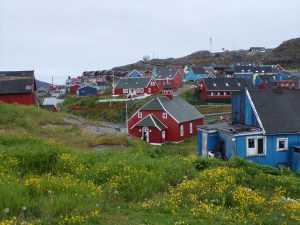
After a couple of coffees and many murky photos from the deck of icebergs, the other cruiser, and lots of distant colourful buildings, it was announced that we would, after all, begin disembarking. I couldn’t help but wonder what arms had been twisted or paperwork submitted to make this happen. Soon, Sue and I were chugging our way through the rain on the first tender to step onto shore, beaten to it by brightly attired passengers from the other ship, who had a slightly shorter journey to make.
Our group of around twelve gathered by the Tourist Information Office and met our guide. She was young, had a calm manner, spoke perfect English, and was of obvious Danish heritage. Through the rain, we followed her as she shared the history and descriptions of the various buildings we paused at, moving on when enough photos had been taken. Some of the structures were as old as the 1700s, but the earliest settlement dates back to 2400 BC. It has always been a harsh place to survive, and there have been many extended periods when there were no inhabitants in the region of Qaqortoq at all. Today, the town serves as the main administrative centre of the area, with the principal industry being fishing. It is also where outlying settlements send their children for secondary education.


The rain did pause for a while, but then the midges arrived and became a nuisance whenever we stood still for any length of time. Sue and I didn’t bother donning our face nets (we’ve experienced much worse), but many others did. We visited the town’s two museums, both small, containing a variety of artefacts and literature that thinly attempt to describe the history of the place. Not surprisingly, there were no interactive displays or high-tech projection equipment here. This is a tough, working settlement, the past is important, but not something to dwell on.
Our tour was titled “Cultural Walking Tour,” but it was disappointing in that we didn’t get a true feel for the people and their way of life, either past or present. Perhaps the dismal weather had something to do with that, but I suspect the town’s 195 inhabitants are simply too busy with their daily lives to spend time explaining how they make it all work to soft Europeans. The maze of roads linking the brightly coloured houses, red for government-owned, blue for fishermen, and green for land workers, was very busy with vehicles, making it difficult to follow our guide through the town in a neat line as we sought to understand the place.

After thoroughly visiting the museums and church, Sue and I took a walk to the town’s other notable feature, the Great Lake. However, it turned out to be far less “great” than its name implies. One group from the ship was booked to complete a hike around it in less than two hours. I felt for them. We made our way to the nearest viewpoint, snapped our photos, and, chased by midges, quickly retreated into town for a return tender to the haven of the Ambience.
The evening show was a tribute to Broadway by an excellent Brazilian singer. He was incredibly professional with a stunning vocal range, and we’re looking forward to his next performance in a few days. It’s another early start tomorrow, so we were off to bed before 11 pm.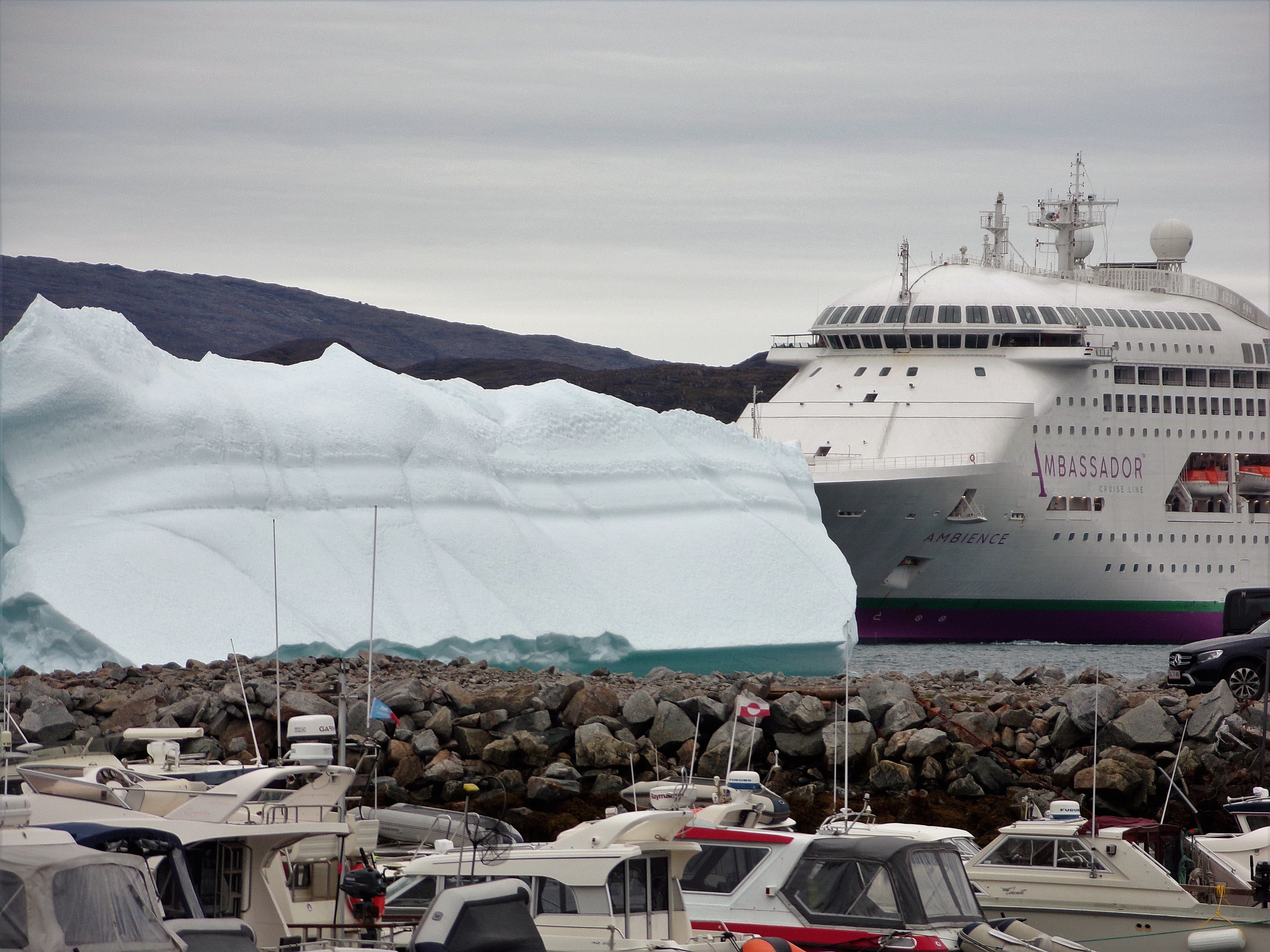


Leave a Reply